Science and Technology By: Jayprakash Mishra 24 Sep, 2026
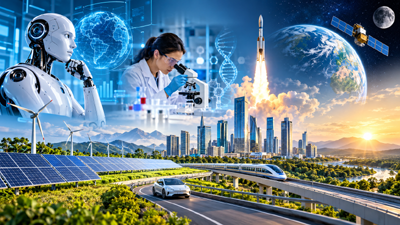
Science and technology have become an essential part of modern life. From the smartphone in our hands to the satellites orbiting Earth, scientific discoveries and technological innovations influence almost every aspect of our daily lives. They have transformed the way we communicate, travel, work, learn, shop, receive healthcare, and understand the world around us.
Science helps us understand how the universe works, while technology uses scientific knowledge to create practical solutions to human problems. Together, they continue to shape society and open new possibilities for the future. As innovation moves forward at an extraordinary pace, understanding the relationship between science and technology has become more important than ever.
Science is the systematic study of the natural world. Scientists observe phenomena, conduct experiments, collect information, develop theories, and test ideas to understand how things work. Fields such as physics, chemistry, biology, astronomy, environmental science, and geology have helped humanity understand everything from microscopic cells to distant galaxies.
Technology, on the other hand, refers to the tools, systems, machines, and processes developed to solve problems or make tasks easier and more efficient. Computers, automobiles, medical equipment, renewable-energy systems, satellites, and communication networks are all examples of technology.
Science and technology are closely connected. Scientific discoveries often lead to technological innovations, while new technologies can give scientists better tools to conduct research. This creates a continuous cycle of discovery, invention, experimentation, and improvement.
Technology is no longer limited to laboratories, factories, or research institutions. It is deeply integrated into everyday life.
Smartphones allow people to communicate instantly, access information, manage finances, navigate unfamiliar places, take photographs, and use thousands of applications. The internet has made information available to billions of people around the world, changing education, entertainment, business, and social interaction.
Smart homes are another example of technological development. Internet-connected devices can control lighting, temperature, security systems, appliances, and other household functions. These technologies can improve convenience and, in some situations, help people use energy more efficiently.
Transportation has also changed significantly. Electric vehicles, advanced navigation systems, high-speed rail, autonomous-driving research, and improved aviation technologies are transforming how people and goods move from one place to another.
One of the most significant technological developments of recent years is artificial intelligence (AI). AI systems can process large amounts of information, identify patterns, generate content, assist with decision-making, and perform tasks that traditionally required human involvement.
AI is being explored and used across many industries. In healthcare, it can assist with medical-image analysis and research. In education, AI-powered systems can support personalized learning. In manufacturing, intelligent systems can monitor machinery and improve production processes. In agriculture, technology can help analyze soil conditions, weather patterns, and crop health.
Generative AI has also introduced new ways to create text, images, audio, video, software, and other forms of digital content. As these systems become more capable, questions about accuracy, privacy, copyright, employment, security, and responsible use are becoming increasingly important.
The future of AI will depend not only on technical progress but also on how responsibly society develops and uses these systems.
Scientific research has dramatically improved healthcare. Advances in biology, genetics, chemistry, medicine, and medical engineering have contributed to better methods of diagnosing, treating, and preventing diseases.
Modern medical technology includes magnetic resonance imaging, computed tomography, robotic surgical systems, wearable health devices, laboratory testing equipment, and digital medical records. These technologies can provide healthcare professionals with valuable information and support more efficient patient care.
Scientific research has also improved our understanding of genetics. Researchers can study DNA to understand inherited characteristics and investigate the biological causes of certain diseases. Advances in biotechnology have opened new areas of research involving gene-based treatments, vaccines, and personalized medicine.
At the same time, healthcare technology must be developed carefully because medical information is highly sensitive. Privacy, cybersecurity, safety, affordability, and ethical considerations remain important challenges.
Science and technology are powerful forces that have transformed the modern world. Science helps humanity understand nature, while technology turns knowledge into practical tools and systems. Together, they contribute to developments in healthcare, communication, transportation, education, energy, agriculture, space exploration, and countless other fields.
From artificial intelligence and renewable energy to biotechnology and space research, innovation is creating new opportunities while also introducing important challenges. Responsible development will require researchers, businesses, governments, educators, and individuals to consider not only what technology can do, but also how it should be used.
The future of science and technology will ultimately depend on human curiosity, creativity, responsibility, and cooperation. By encouraging scientific thinking and using technology thoughtfully, society can continue to discover new possibilities and build a more connected, efficient, and informed world.
Science discovers the possibilities. Technology turns those possibilities into reality.


